

JEDAI: Jet Exploration for Detecting anomalies with AI
Sabine Crépé-Renaudin,
Research Director, LPSC, CNRS
crepe@in2p3.fr
Julien Donini,
Professor, LPCA, UCA
julien.donini@uca.fr
DESCRIPTION
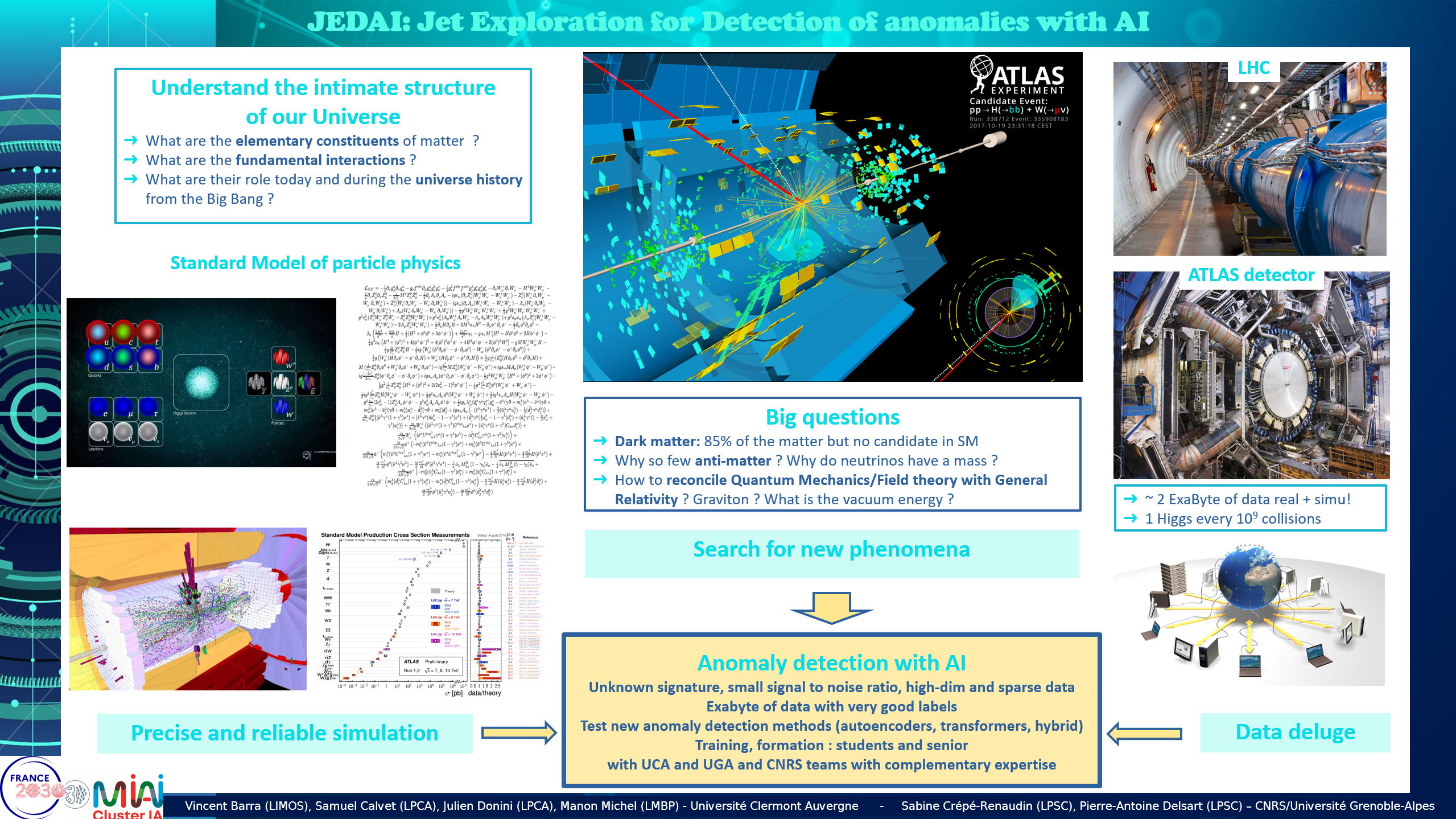
The JEDAI project focuses on the development of machine learning (ML) methods for detecting anomalies in complex, massive, and multidimensional data, such as the vast amount produced at the Large Hadron Collider (LHC) at CERN. The primary physics objective is to analyze the proton-proton collision data collected by the ATLAS experiment at the LHC to identify anomalies that could indicate the presence of new physical processes. For this, the JEDAI team will explore the nature of jets – a spray of collimated particles resulting from the radiation of a quark or gluon – as these are produced in large quantities by fundamental physical processes and could be the signature of new particles, predicted in certain dark matter models, for example. Anomaly detection (AD) is a difficult problem requiring artificial intelligence solutions adapted to the many characteristics and nature of the anomalies. The anomalies sought at LHC are expected to be very rare, difficult to distinguish from background noise and even unknown. This project promises to explore and develop ML techniques for anomaly detection, prove their validity and effectiveness by applying them to unique LHC data, and disseminate the resulting methodologies.
A teaching and training program is associated with this project: up to four new courses will be offered to students. Most of the educational initiatives will initially be hosted at UCA,before being considered at UGA (duplication or transformation of courses).
ACTIVITIES
For teaching-related activities, a pedagogical engineer will be recruited at UCA in the fall of 2026 for a period of two years (60% of the time, shared with another chair).
CHAIR PRESENTATION
License:
You may view and share them for non-commercial purposes, without modification, and with appropriate credit to the authors.